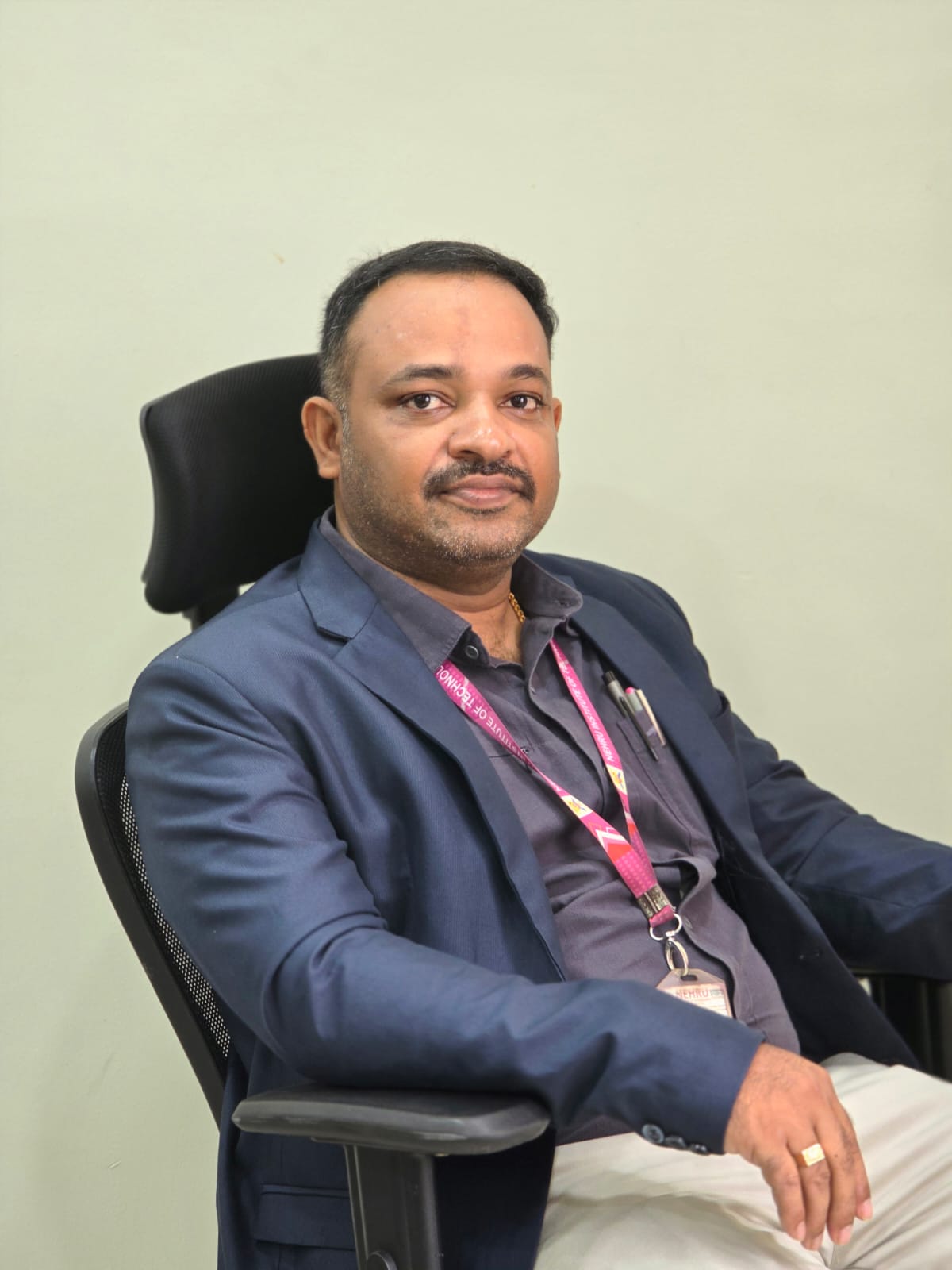
“FUELLING AND SKYROCKETING YOUR DREAMS”
With Extreme gladness, I welcome you all to the Department of Aeronautical Engineering established in the year of 2008 with a vision to produce technically competent engineers for serving the nation. The Department is Longstanding in the institute by crossing a decade and becomes a primary identity of the institution through the laurels it has attained so far.
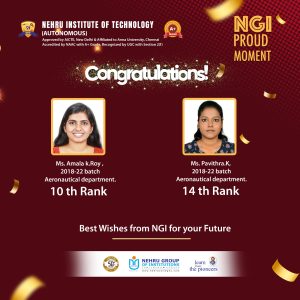
The Department has produced many university rank holders in end semester examinations through knowledge dissemination in a well structured academic module in par with universal standards. The Department caters the technical demand of every student during course duration through detailed lecture and practical sessions, thought provoking technical workshops, seminars, conferences and activity based competitions.
The Department has a very strong industry tie up with many leading industries and startups to have an enriched knowledge about the discipline for preparing the student community to meet the swifty changes in the industry under all aspects. The student community actively participates in sessions about the latest developments of the discipline to understand the changes through expert talks from premier institutions such as IIT, NIT and top notch industries. The rigorous and vibrant faculty team represents the department by contributing high value research articles to journals, book chapters and conference proceedings. The faculty team deliberately involves them in molding the student for transition to be a notable entrepreneur or an outstanding skilled professional. UG degree in Aeronautical Engineering opens up favorable opportunities for high studies and careers with leading government organizations such as ISRO, NASA, DRDO, HAL, NAL and MRO with a bright future.
I assure the success of every student joining B.E., Aeronautical Engineering at NIT to foresee a career with abundant academic prospects and professional values.
PEO1 | Ability to apply fundamental concepts in mathematics, science and engineering to develop cost – effective airborne systems with reasonable considerations of safety, social and environmental aspects. |
PEO2 | Ability to design and research in the domain area of aeronautical engineering and to train professionals. |
PEO3 | Ability to contribute effectively as a member or as a leader in a team to handle projects of national interest and pursue research based on competency-based education and life – long learning. |
PSO1
| Professional skills Able to utilize the knowledge of aeronautical/aerospace engineering in innovative, dynamic and challenging environment for design and development of new products. |
PSO2 | Problem solving skills Imparted through simulation language skills and general-purpose CAE packages to solve practical, design and analysis problems of components to complete the challenge of airworthiness for flight vehicles. |
PSO3 | Practical implementation and testing skills Providing different types of in house and training and industry practice to fabricate and test and develop the products with more innovative technologies.
|
PO1 | Engineering Knowledge – Apply knowledge of mathematics, natural science, computing, engineering fundamentals, and an engineering specialization to develop solutions to complex engineering problems as specified in WK1 to WK4. |
PO2 | Identify, formulate, review research literature, and analyze complex engineering problems to reach substantiated conclusions with consideration for sustainable development (WK1 to WK4). |
PO3 | Design/Development of Solutions – Design creative solutions for complex engineering problems and design/develop systems/components/processes to meet identified needs with consideration for public health and safety, whole-life cost, net zero carbon, culture, society, and environment (WK5). |
PO4 | Conduct Investigations of Complex Problems – Use research-based knowledge, including design of experiments, modeling, analysis, and interpretation of data, to provide valid conclusions when investigating complex engineering problems (WK8). |
PO5 | Engineering Tool Usage – Create, select, and apply appropriate techniques, resources, and modern engineering and IT tools (including prediction and modeling) for solving complex engineering problems while recognizing their limitations (WK2 and WK6). |
PO6 | The Engineer and The World – Analyze and evaluate societal and environmental aspects while solving complex engineering problems with attention to economy, health, safety, legal framework, culture, and environment (WK1, WK5, and WK7). |
PO7 | Apply ethical principles and commit to professional ethics, human values, diversity and inclusion; adhere to national and international laws (WK9). |
PO8 | Individual and Collaborative Team Work – Function effectively as an individual, and as a member or leader in diverse/multidisciplinary teams. |
PO9 | Communication – Communicate effectively and inclusively within the engineering community and society at large, including writing effective reports, design documentation, and making effective presentations that consider cultural, language, and learning differences. |
PO10 | Project Management and Finance – Apply engineering management principles and economic decision-making, manage projects and one’s work as a member and leader in a team. |
PO11 | Life-Long Learning – Recognize the need for, and prepare for, independent and life-long learning, adaptability to new challenges, and engage in continuous technological change in multidisciplinary environments. |
Graduates in Aeronautical Engineering have excellent career opportunities in aviation, aerospace, defense, manufacturing, research, and emerging technologies. This course trains an engineer in designing, constructing, analyzing, testing, developing, and manufacturing commercial and military aircraft, missiles, and spacecraft. While aeronautics focuses on systems operating within Earth's atmosphere, astronautics centers on those operating in space.
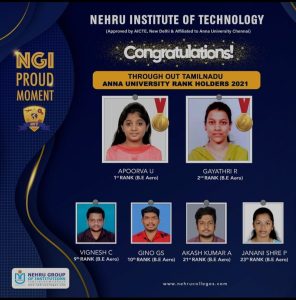
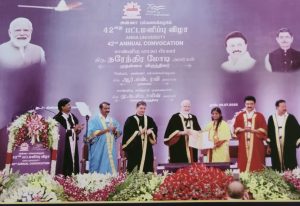
Ms.Apoorva .U, B.E Aeronautical Engineering (2017 - 2021 batch )studied under the Nehru Vigyan Scholarship Bagged Gold Medal & University First Rank , Received from Honourable Prime Minister
| WK1 | Systematic, theory-based understanding of natural sciences and awareness of relevant social sciences for the discipline. |
| WK2 | Conceptually-based mathematics, numerical analysis, data analysis, statistics, and formal aspects of computer and information science supporting analysis and modeling. |
| WK3 | Systematic, theory-based formulation of engineering fundamentals required in the discipline. |
| WK4 | Engineering specialist knowledge with theoretical frameworks and practice area knowledge at the forefront of the discipline. |
| WK5 | Knowledge supporting efficient resource use, environmental impact, life cycle cost, net zero carbon, and similar concepts in practical design and operations. |
| WK6 | Knowledge of engineering practice (technology) in the discipline’s practice areas. |
| WK7 | Knowledge of the engineering role in society, professional responsibility, public safety, and sustainable development. |
| WK8 | Engagement with current research literature, critical thinking, and creative evaluation of emerging issues. |
| WK9 | Ethics, inclusive behavior, engineering responsibilities, diversity awareness, and inclusive attitudes. |


